
Nurses at White Plains Hospital
Giving back to the communities where we do business is central to the DNA of Atlas Air Worldwide. It is a huge source of pride and joy for our family of companies. Over the course of this ongoing pandemic, we have had the opportunity to give back to our local communities and use our resources to thank those who are doing so much for all of us.
The neighboring communities surrounding our Purchase headquarters were hard-hit by the coronavirus. Local hospitals were pushed to the limit as they struggled to cope with a rapidly rising number of cases while grappling with a shortage of PPE.
The Radiology Staff at White Plains Hospital with boxes of cookies
Our team in Headquarters answered the call for help by donating 5,000 N95 masks and making a corporate donation to White Plains Hospital in support of their COVID19 relief efforts. Brandon Cole, Vice President, Operations thanked Atlas for their support “during this very challenging time.”
As the Easter Sunday and Passover holiday weekend approached, Atlas saw another opportunity to support White Plains Hospital and arranged for catered dinner for 50 healthcare workers.
Jamie Bocchino, Community Relations & Events Manager, said the staff were thrilled to receive the food, which “put many smiles on our employees’ faces.”
Pictured on the right is Ellen P. Muentener, Director of Volunteers with Luda Samuels, Volunteer Coordinator receiving Atlas’ lunch donation at Northern Westchester Hospital in Mt. Kisco from longtime Atlas driver, Alberto Martinez, who delivered the food.
As another example of Headquarters’ community support, Atlas also coordinated lunch for 60 people (doctors, nurses and staff) or 3 floors (of 20 people) at Northern Westchester Hospital in Mt. Kisco.
Debbie Diachenko, Executive Assistant, Treasury played a key role in coordinating the meal donations. “This was a very rewarding effort and I appreciated the opportunity to be involved. It gives me great pride to work for a company that is committed to helping those working on the front lines in such tragic times.”
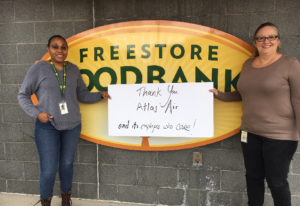
Freestore Foodbank Thanks Atlas Employees
Even under normal conditions, supporting our local communities is a big focus for Atlas. In CVG, the need for community support on multiple fronts in the face of the coronavirus pandemic was clear and our teams rallied quickly to help.
Within hours of learning the worldwide shortage of PPE for healthcare workers was playing out in their neighborhood, our CVG-based teams led by Jamie Handley, Vice President of Express Operations and Tom Killian, Director of Ground Operations arranged for the delivery of 2,000 masks to St. Elizabeth Healthcare in Northern Kentucky.
“Wow. What an amazing call to receive,” said Garren Colvin, President and CEO of St. Elizabeth Healthcare. “We pride ourselves on our commitment to serving the community, so we appreciate like-minded partners, such as Atlas, helping us protect our staff.”
Days later, the CVG team stepped up again when they learned that Aitheras Aviation Group, the aviation partner for the Cleveland Clinic, was in need of personal protective equipment (PPE) for its flight crews.
George Katsikas, President and CEO of Aitheras Aviation Group, said additional PPE was needed for the crews to safely transport critically ill patients and organs for life-saving transplants.
“We appreciate Atlas Air Worldwide answering the call so quickly,” Katsikas said. “The masks the team donated have made a significant impact on our ability to keep our crews safe.”
Killian said he is proud to be a part of the effort to support the important work of those working on the front line. “The healthcare workers at St. Elizabeth and the crews at Aitheras are under extraordinary pressure as they do their life-saving work,” Killian said. “We were honored to be able to make these donations happen quickly for them. It was a great team effort.”
As another example of the CVG team’s community support, after learning of the critical need of the region’s Freestore Foodbank, Tracy Duwel, Director of Human Resources, worked quickly to support it through an incredible Atlas Act of Kindness.
In acknowledgment of that need, Atlas donated $10,000 to the Freestore Foodbank, which supports more than 500 community food pantries in 20 counties throughout Northern Kentucky, Southern Ohio and Eastern Indiana.
Atlas’s donation was doubled to $20,000 through a matching gift from the Foodbank’s long-time donor. The funds will help the organization fulfill its mission to serve an estimated 270,000 food-insecure people, including 80,000 children.
“This incredibly generous gift from Atlas Air Worldwide comes at a critical time for our neighbors in need,” said Kurt Reiber, President and CEO of the Freestore Foodbank. “We so appreciate Atlas employees who care!”
Giving back to the communities where we do business is central to the DNA of Atlas Air Worldwide and a huge source of pride and joy for our company. Over the past few weeks, we have had the opportunity to give back to our community and use our resources to say thank you to those who are doing so much for us.
Following the recent launch of Atlas Acts of Kindness, the Company made a donation to Covenant House in New York City. For over 40 years Covenant House has remained committed to the life-saving work of serving youth experiencing homelessness. Their shelter and services are especially critical during the current COVID-19 outbreak, and they are doing everything possible to ensure the health and safety of all residents and staff who remain on site. While the rest of the world closed, Covenant House “opened their arms wider to protect youth experiencing homelessness.”
In that same spirit, Covenant House’s annual gala, A Night of Covenant House Stars, will still go on. On May 18 at 8:00 p.m. Eastern, we hope you’ll tune into a one-of-a-kind benefit concert to support COVID-19 relief efforts for homeless, trafficked and at-risk youth, available on a number of streaming platforms, entertainment and social media sites and SmartTVs. To learn more about this incredible event that we are sponsoring, the stars who will be performing, or to make a donation, please visit the event website.
Here at Atlas, we believe one small act of kindness can change a life, and together, we can change the world.
Negotiations for Joint Collective Bargaining Agreement Continue
PURCHASE, N.Y., May 7, 2020 – Atlas Air Worldwide Holdings, Inc. (Nasdaq: AAWW) today announced that its wholly-owned subsidiaries Atlas Air, Inc. and Southern Air, Inc. have reached an agreement with International Brotherhood of Teamsters (IBT) Locals 2750 and 1224 for an interim pay increase for their pilots. The ten percent pay increase is effective as of May 1.
“We wanted to provide this interim increase to our pilots who are working so hard during this difficult time. Reaching this agreement with our IBT Locals underscores our deep appreciation of the efforts of our pilots,” said John W. Dietrich, President and Chief Executive Officer, Atlas Air Worldwide. “While we continue to manage through this current pandemic situation, we also remain focused on completing the joint collective bargaining agreement we have been pursuing in connection with the merger between Atlas Air and Southern Air.”
The company and the IBT have been in merger negotiations for a joint contract for the more than 2,200 pilots that fly for Atlas Air and Southern Air.
About Atlas Air Worldwide:
Atlas Air Worldwide is a leading global provider of outsourced aircraft and aviation operating services. It is the parent company of Atlas Air, Inc., Southern Air Holdings, Inc. and Titan Aviation Holdings, Inc., and is the majority shareholder of Polar Air Cargo Worldwide, Inc. Our companies operate the world’s largest fleet of 747 freighter aircraft and provide customers the broadest array of Boeing 747, 777, 767 and 737 aircraft for domestic, regional and international cargo and passenger operations.
Atlas Air Worldwide’s press releases, SEC filings and other information may be accessed through the company’s home page, www.atlasairworldwide.com.
* * *
PURCHASE, N.Y., May 7, 2020 – Atlas Air Worldwide Holdings, Inc. (Nasdaq: AAWW) today announced first-quarter 2020 net income of $23.4 million, or $0.90 per diluted share, compared with a reported loss of $29.7 million, or $1.15 per diluted share, in the first quarter of 2019.
Reported results in the first quarter of 2020 included an unrealized gain on outstanding warrants of $0.9 million, compared with an unrealized loss on outstanding warrants of $46.6 million in the year-ago period.
On an adjusted basis, EBITDA totaled $121.2 million in the first quarter this year compared with $120.4 million in the first quarter of 2019. Adjusted net income in the first quarter of 2020 totaled $29.9 million, or $1.15 per diluted share, compared with $27.3 million, or $0.98 per diluted share, in the prior-year period.
“Our thoughts are with everyone who has been affected by the COVID-19 pandemic. I would like to thank all of our employees and the frontline responders around the world for their tremendous efforts to combat this crisis,” said Atlas Air Worldwide President and Chief Executive Officer John W. Dietrich.
“As always, safety is our top priority, and we are focused on supporting our pilots and ground staff through this challenging time. We are very fortunate to be able to continue to carry the goods that the world needs.
“We are taking extensive precautions to safeguard all of our employees and working in close partnership with our pilots and their union leadership to ensure that our operations continue safely.
“We are deep cleaning our aircraft and facilities on a frequent basis, providing safety kits for our ground staff and crewmembers, and implementing many other safety procedures to protect our team, customers and service providers. We are also adjusting routes and schedules to limit exposure to regions that have been more significantly impacted by the pandemic. We have also put in place significant social distancing and other precautionary measures in our offices, including having all employees who can work remotely from home do so.
“We are also pleased to have announced earlier today that, at the company’s offering, we reached an agreement with our pilot unions at Atlas Air and Southern Air for an interim pay increase of 10%, effective May 1. This recognizes the outstanding efforts that our pilots provide every day, and especially in this challenging operating environment. We also remain focused on completing the joint collective bargaining agreement we have been pursuing in connection with our merger between Atlas Air and Southern Air.”
Mr. Dietrich added: “After a slow start, and despite the continual and varying operational challenges and uncertainties related to COVID-19, we ended the quarter with results that exceeded our expectations.
“Our results reflected increased charter cargo demand and higher airfreight yields in March. They also reflect the vital role that Atlas plays in supporting the global economy and our customers by keeping goods moving.
“From parts and components used in manufacturing processes to finished products, food, pharmaceuticals, supplies and other cargo, businesses and individuals count on Atlas.
“And we are grateful to be able to provide relief to businesses and communities in the fight against COVID-19. In addition to our commercial operations, we donated services to transport critical personal protective equipment and other necessary supplies to affected areas. We have also made several charitable contributions to organizations that help those in need.
“The strong demand for airfreight has carried into the second quarter. To meet that demand, we reactivated three of our 747 converted freighters that had been parked, and began operating a 777F that was previously in our dry-leasing business.
“At the same time, we are mindful of the evolving and uncertain environment and the importance of prudent financial management. We are taking actions to reduce costs and enhance liquidity, including significantly reducing discretionary spending, limiting our hiring for certain positions and selling nonessential assets.”
Mr. Dietrich continued: “With an exceptionally talented team of employees, a strong balance sheet, and a diversified portfolio of assets and services, Atlas continues to be well-positioned to adjust to market conditions, navigate through the current pandemic, and leverage the scale of our operations to further capitalize on business opportunities.
“We expect the positive trends that we are currently experiencing to continue throughout the remainder of the year, and we expect a majority of our earnings to occur in the second half of this year. The evolving and uncertain environment related to COVID-19 makes it difficult to accurately predict the future impact on our results. As such, we are providing an outlook for the second quarter of 2020, but our full-year 2020 guidance provided on February 20 of this year no longer applies, and we will provide updates as the year progresses.
“We expect to fly approximately 80,000 block hours in the second quarter of 2020, with revenue of approximately $770 million, and adjusted EBITDA of about $165 million. Excluding the benefit from a refund of excess aircraft rent paid in previous years of approximately $25.0 million, after tax, we anticipate adjusted net income to grow approximately 40% to 50% compared with adjusted net income of $29.9 million in the first quarter of 2020.
“Including the benefit from a refund of excess aircraft rent paid in previous years, we anticipate adjusted net income to more than double compared with the first quarter of this year.”*
First-Quarter Results
Volumes in the first quarter of 2020 totaled 73,247 block hours compared with 77,061 in the first quarter of 2019, with revenue of $643.5 million compared with $679.7 million in the prior-year period.
Lower ACMI segment revenue in the first quarter of 2020 reflected a decrease in flying, primarily driven by the redeployment of 747-400 aircraft to the Charter segment as well as customer flight cancellations caused by the COVID-19 pandemic, partially offset by an increase in 777, 737 and 747-400 CMI flying.
Higher ACMI segment contribution was primarily due to an increase in CMI flying and a reduction in aircraft rent and depreciation, partially offset by the redeployment of 747-400 aircraft to the Charter segment. In addition, segment contribution was negatively impacted by the COVID-19 pandemic, which resulted in customers canceling flights and increased operating costs for us, including premium pay for crews operating in certain areas significantly impacted by the virus.
Higher Charter segment revenue during the period was primarily driven by increased flying, partially offset by a decrease in the average rate per block hour. Block-hour volume growth primarily reflected the strong demand for commercial cargo, driven by a reduction of available capacity in the market and the disruption of global supply chains due to the COVID-19 pandemic, and the redeployment of 747-400 aircraft from the ACMI segment. This was partially offset by lower AMC passenger flying as the military took precautionary measures to limit the movement of personnel. The lower average rate per block hour was primarily related to a reduction in Charter capacity purchased from ACMI customers that had no associated Charter block hours and lower fuel prices, partially offset by an increase in commercial cargo yields (excluding fuel).
Higher Charter segment contribution was primarily driven by an increase in commercial cargo yields (excluding fuel), reflecting a reduction of available capacity in the market and the disruption of global supply chains due to the COVID-19 pandemic. Segment contribution also benefited from lower aircraft rent and depreciation, and the redeployment of 747-400 aircraft from the ACMI segment. These improvements were partially offset by lower AMC passenger demand and increased operating costs, including premium pay for crews operating in certain areas impacted by COVID-19.
In Dry Leasing, lower segment revenue and contribution in the first quarter of 2020 primarily reflected that the prior-year quarter included $22.3 million ($17.9 million after tax) of revenue from maintenance payments related to the scheduled return of a 777 freighter.
Higher unallocated income and expenses, net, during the quarter primarily reflected an insurance recovery in the first quarter of 2019 and increased amortization of a customer incentive asset.
Reported earnings in the first quarter of 2020 also included an effective income tax expense rate of 27.4%, due mainly to tax expense from the vesting of share-based compensation. On an adjusted basis, our results reflected an effective income tax rate of 24.2%.
Cash and Short-Term Investments
At March 31, 2020, our cash and cash equivalents, short-term investments and restricted cash totaled $235.6 million, compared with $114.3 million at December 31, 2019.
The change in position resulted from cash provided by operating, investing and financing activities.
Net cash provided by investing activities during the first quarter of 2020 primarily related to proceeds from the disposal of aircraft, partially offset by capital expenditures and payments for flight equipment and modifications, including spare engines and GEnx engine performance upgrade kits.
Net cash provided by financing activities during the period primarily related to proceeds from debt refinancing and from our revolving credit facility, partially offset by payments on debt obligations. In March 2020, as a precautionary measure due to the uncertainty from the COVID-19 pandemic, we drew $75.0 million under our revolving credit facility and had $19.8 million of unused availability as of March 31, 2020.
Our ability to continue to service our debt and meet our lease and other obligations as they come due is dependent on our continued ability to generate earnings and cash flows. To mitigate the impact of any continuation or worsening of the COVID-19 pandemic disruptions, we have significantly reduced nonessential employee travel, reduced the use of contractors, limited ground staff hiring, implemented a number of other cost-reduction initiatives and taken other actions, such as the sale of certain nonessential assets. We believe we will generate sufficient liquidity to satisfy our obligations over at least the next twelve months.
Updating Outlook*
We expect the positive trends that we are currently experiencing to continue throughout the remainder of the year, and expect a majority of our earnings to occur in the second half of this year. The evolving and uncertain environment related to COVID-19 makes it difficult to accurately predict the future impact on our results. As such, we are providing an outlook for the second quarter of 2020, but our full-year 2020 guidance provided on February 20 of this year no longer applies, and we will provide updates as the year progresses.
We expect to fly approximately 80,000 block hours in the second quarter of 2020, with revenue of approximately $770 million, and adjusted EBITDA of about $165 million. Excluding the benefit from a refund of excess aircraft rent paid in previous years of approximately $25.0 million (after tax), we anticipate adjusted net income to grow approximately 40% to 50% compared with adjusted net income of $29.9 million in the first quarter of 2020. Including the benefit from a refund of excess aircraft rent paid in previous years, we anticipate adjusted net income to more than double compared with the first quarter of 2020.*
We expect that earnings in the second quarter will benefit from continued charter demand, including several long-term charter programs at higher yields, driven by a reduction of airfreight capacity, increased demand for transporting goods and the disruption of global supply chains related to COVID-19; a refund of excess aircraft rent paid in previous years; flying the incremental CMI aircraft added to our fleet during 2019; and improved operating efficiencies and cost savings.
We also expect these benefits to be partially offset by higher heavy maintenance expense; lower AMC demand driven by the military’s stop-movement order related to COVID-19; additional costs driven by COVID-19, including crew premium pay; other operational costs, including costs for continuing to provide a safe working environment for our employees; and higher crew costs related to increased pay rates resulting from our recent interim agreement with the pilots.
In addition, the availability of hotels and restaurants, evolving COVID-19-related travel restrictions and health screenings, and cancellations of passenger flights by other airlines or airport closures could further impact our ability to position pilots to operate our aircraft.
The second-quarter outlook also reflects the reactivation of three of our 747 converted freighters that had been previously parked, and our operation of a 777F that was previously in our dry-leasing business driven by the continued strong airfreight demand.
While we are not providing an earnings outlook for the full year of 2020 at this time, we expect a majority of our earnings to occur in the second half of the year. Aircraft maintenance expense in 2020 is expected to total approximately $390 million. Depreciation and amortization is expected to total about $250 million. In addition, core capital expenditures, which exclude aircraft and engine purchases, are projected to total approximately $85 to $95 million, mainly for parts and components for our fleet.
We also expect our full-year 2020 adjusted effective income tax rate to be approximately 22.0%.
We provide guidance on an adjusted basis because we are unable to predict, with reasonable certainty, the effects of our outstanding warrant liability and other items that could be material to our reported results.*
Conference Call
Management will host a conference call to discuss Atlas Air Worldwide’s first-quarter 2020 financial and operating results at 11:00 a.m. Eastern Time on Thursday, May 7, 2020.
Interested parties may listen to the call live at Atlas Air Worldwide’s Investor site or at https://edge.media-server.com/mmc/p/erawj6pw.
For those unable to listen to the live call, a replay will be archived on the Investor site following the call. A replay will also be available through May 14 by dialing (855) 859-2056 (U.S. Toll Free) or (404) 537-3406 (from outside the U.S.) and using Access Code 9238139#.
About Non-GAAP Financial Measures
To supplement our financial statements presented in accordance with U.S. GAAP, we present certain non-GAAP financial measures to assist in the evaluation of our business performance. These non-GAAP measures include Adjusted EBITDA; Adjusted net income; Adjusted Diluted EPS; Adjusted effective tax rate; and Free Cash Flow, which exclude certain noncash income and expenses, and items impacting year-over-year comparisons of our results. These non-GAAP measures may not be comparable to similarly titled measures used by other companies and should not be considered in isolation or as a substitute for Net income (loss); Diluted EPS; Effective tax rate; and Net Cash Provided by Operating Activities, which are the most directly comparable measures of performance prepared in accordance with U.S. GAAP. Effective during the three months ended September 30, 2019, we changed our method of calculating Adjusted EBITDA to include Other Non-operating expenses (income) to enhance the usefulness for investors and analysts, and the comparability of the calculation to that of other companies. Prior period amounts have been adjusted for comparability.
Our management uses these non-GAAP financial measures in assessing the performance of the company’s ongoing operations and in planning and forecasting future periods. We believe that these adjusted measures, when considered together with the corresponding U.S. GAAP financial measures and the reconciliations to those measures, provide meaningful supplemental information to assist investors and analysts in understanding our financial results and assessing our prospects for future performance. For example:
Free Cash Flow helps investors assess our ability, over the long term, to create value for our shareholders as it represents cash available to execute our capital allocation strategy.
*We provide guidance on an adjusted basis and are unable to provide forward-looking guidance on a U.S. GAAP basis or a reconciliation to the most directly comparable U.S. GAAP measures because we are unable to predict with reasonable certainty the ultimate outcome of certain significant items. The principal item is the impact on our results of our outstanding warrant liability, which are highly dependent on the change in our stock price during the period reported. These items are uncertain, depend on various factors, and could have a material impact on our U.S. GAAP results.
About Atlas Air Worldwide:
Atlas Air Worldwide is a leading global provider of outsourced aircraft and aviation operating services. It is the parent company of Atlas Air, Inc., Southern Air Holdings, Inc. and Titan Aviation Holdings, Inc., and is the majority shareholder of Polar Air Cargo Worldwide, Inc. Our companies operate the world’s largest fleet of 747 freighter aircraft and provide customers the broadest array of Boeing 747, 777, 767 and 737 aircraft for domestic, regional and international cargo and passenger operations.
Atlas Air Worldwide’s press releases, SEC filings and other information may be accessed through the company’s home page, www.atlasairworldwide.com.
This release contains “forward-looking statements” within the meaning of the Private Securities Litigation Reform Act of 1995 that reflect Atlas Air Worldwide’s current views with respect to certain current and future events and financial performance. Those statements are based on management’s beliefs, plans, expectations and assumptions, and on information currently available to management. Generally, the words “will,” “may,” “should,” “expect,” “anticipate,” “intend,” “plan,” “continue,” “believe,” “seek,” “project,” “estimate,” and similar expressions used in this release that do not relate to historical facts are intended to identify forward-looking statements.
Such forward-looking statements speak only as of the date of this release. They are and will be, as the case may be, subject to many risks, uncertainties and factors relating to the operations and business environments of Atlas Air Worldwide and its subsidiaries (collectively, the “companies”) that may cause the actual results of the companies to be materially different from any future results, express or implied, in such forward-looking statements.
Factors that could cause actual results to differ materially from these forward-looking statements include, but are not limited to, the following: our ability to effectively operate the network service contemplated by our agreements with Amazon; our ability to coordinate with Amazon to accept newly converted aircraft; the possibility that Amazon may terminate its agreements with the companies; the ability of the companies to operate pursuant to the terms of their financing facilities; the ability of the companies to obtain and maintain normal terms with vendors and service providers; the companies’ ability to maintain contracts that are critical to their operations; the ability of the companies to fund and execute their business plan; the ability of the companies to attract, motivate and/or retain key executives, pilots and associates; the ability of the companies to attract and retain customers; the continued availability of our wide-body aircraft; demand for cargo services in the markets in which the companies operate; changes in U.S. and foreign government trade policies; economic conditions; the impact of geographical events or health epidemics such as the COVID-19 pandemic; the effects of any hostilities or act of war (in the Middle East or elsewhere) or any terrorist attack; significant data breach or disruption of our information technology systems; labor costs and relations, work stoppages and service slowdowns; the outcome of pending negotiations with our pilots’ union; financing costs; the cost and availability of war risk insurance; aviation fuel costs; security-related costs; competitive pressures on pricing (especially from lower-cost competitors); volatility in the international currency markets; weather conditions; government legislation and regulation; consumer perceptions of the companies’ products and services; anticipated and future litigation; and other risks and uncertainties set forth from time to time in Atlas Air Worldwide’s reports to the United States Securities and Exchange Commission.
For additional information, we refer you to the risk factors set forth under the heading “Risk Factors” in the most recent Annual Report on Form 10-K and subsequent reports on Form 10-Q filed by Atlas Air Worldwide with the Securities and Exchange Commission. Other factors and assumptions not identified above may also affect the forward-looking statements, and these other factors and assumptions may also cause actual results to differ materially from those discussed.
Except as stated in this release, Atlas Air Worldwide is not providing guidance or estimates regarding its anticipated business and financial performance for 2020 or thereafter.
Atlas Air Worldwide assumes no obligation to update such statements contained in this release to reflect actual results, changes in assumptions or changes in other factors affecting such estimates other than as required by law and expressly disclaims any obligation to revise or update publically any forward-looking statement to reflect future events or circumstances.
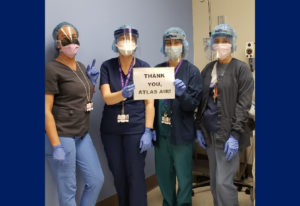 It was the Friday after Atlas’ support of Project Airbridge. Overwhelmed by the shortage of critical personal protective equipment (PPE) for those on the frontline, Jackie Marcus, Vice President Supply Chain at NYU Langone Health, thought maybe Atlas could help.
“We received their call asking if we could help, late on a Friday night – and we immediately responded ‘yes,’” said Michael Steen, Executive Vice President and Chief Commercial Officer. “We knew this was mission critical as their supplies were rapidly depleting. Our team immediately flew into action to find a solution.”
The Atlas commercial team in HDQ and in Asia worked with Flexport, our forwarding partner, to coordinate with NYU and its vendors to get the supplies en route as quickly as possible.
After much careful planning and collaboration across time zones and stations, Atlas Air was pleased to donate and execute the transportation. Two flights were operated for this mission, including one from Shanghai to New York City’s John F. Kennedy International Airport on April 9, and a second from Shanghai to Chicago’s O’Hare International Airport on April 13. Each 747-400 freighter was filled with medical gowns, face shields and masks necessary to protect frontline responders from the coronavirus.
“We are grateful to our crew and ground staff for working to make this happen,” said Michael. “The NYU Langone front line responders are our true heroes. We were humbled and honored to have the opportunity to show our support.”
Purchase, NY – Thursday, April 16, 2020 – Atlas Air Worldwide Holdings, Inc. (NASDAQ: AAWW) today announced that its subsidiary, Atlas Air Inc., donated air cargo transport to NYU Langone Health for critical personal protective equipment (PPE). Two flights were operated for this mission, including one from Shanghai to New York City’s John F. Kennedy International Airport on April 9, and a second from Shanghai to Chicago’s O’Hare International Airport on April 13. The Atlas Air-operated Boeing 747-400 freighters were filled with medical gowns, face shields and masks necessary to safeguard frontline responders dealing with the coronavirus pandemic. Atlas Air Worldwide’s headquarters is located in the New York area served by NYU Langone.
“The COVID-19 pandemic has greatly impacted the accessibility of PPE for healthcare workers at NYU Langone Health, and across the world,” says Robert I. Grossman, MD, Chief Executive Officer of NYU Langone Health and dean of NYU Grossman School of Medicine. “We extend our heartfelt thanks to Atlas Air for their extraordinary generosity, and for their efforts to ensure that our community is well-equipped in our ongoing battle against COVID-19.”
Since the coronavirus pandemic spread through New York City, care teams across NYU Langone Health’s system have selflessly devoted themselves to treating affected patients.
“We are grateful to our neighbor NYU Langone for treating those in our New York community, and are inspired by their medical teams who are on the front lines,” said John W. Dietrich, President and Chief Executive Officer, Atlas Air Worldwide. “We are proud to do our part to help the frontline responders continue to meet the overwhelming needs of New York City and the surrounding area. We thank our extraordinary crewmembers and ground staff for their tireless efforts in making these relief missions possible.”
Atlas Air Worldwide and its subsidiaries have been involved in a number of mission critical transports to support frontline heroes, including coordination in the U.S. with the President’s Coronavirus Task Force, the Federal Emergency Management Agency (FEMA), Flexport.org’s Frontline Responders Fund, and outside the U.S. with sovereign leadership and international business partners.
About Atlas Air Worldwide:
Atlas Air Worldwide is a leading global provider of outsourced aircraft and aviation operating services. It is the parent company of Atlas Air, Inc., Southern Air Holdings, Inc. and Titan Aviation Holdings, Inc., and is the majority shareholder of Polar Air Cargo Worldwide, Inc. Our companies operate the world’s largest fleet of 747 freighter aircraft and provide customers the broadest array of Boeing 747, 777, 767 and 737 aircraft for domestic, regional and international cargo and passenger operations.
Atlas Air Worldwide’s press releases, SEC filings and other information may be accessed through the company’s home page, www.atlasairworldwide.com.
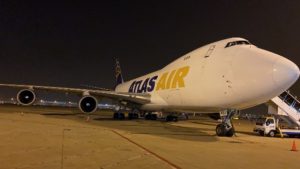
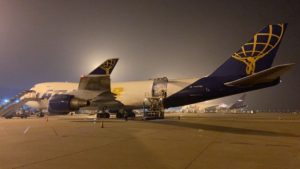

When asked to describe her role at Atlas, LaVerne Bowman, Senior Manager, Systems Development for Ground Operations begins by saying, “I have the best position in the company!” LaVerne has been with Atlas for 15 years and over the course of her career, she has had six different roles, working her way up with each one.
LaVerne’s interest in aviation began when she was in high school.

LaVerne at train station traveling in Hong Kong during a station audit
“We had a program in school called City As School, whereby students could explore future careers” said LaVerne. “The idea behind the program was to pair students with professionals and engage them in a collaborative project. I participated as an intern at NASA’s Goddard Institute for Space Studies at Columbia University and my project focused on the program called Institute on Climate and Planets. During the internship, I attended a conference where I introduced Franklin Chang Díaz as the keynote speaker. He is a Costa Rican American mechanical engineer, physicist and former NASA astronaut. His story was truly inspiring to me. When the internship was over, I had learned a lot about aviation and knew I wanted to pursue a career in this field.”
The next step for LaVerne was Embry-Riddle Aeronautical University in Florida where she received a degree in Aerospace Studies with a minor in Business, Communications and Aerospace Studies.
After college, LaVerne found Atlas. “I saw the company listed on my career page at school and thought it could be a good fit. LaVerne was invited to come in for an interview and eventually was offered a position in Ground Ops as Flight Support Coordinator and Cargo Movement Specialist.
LaVerne on a flight while completing a station audit
In that first role, she ensured punctual departures and cost-effective flights by coordinating and implementing diverse logistical details for global, commercial air cargo charters.
“That role provided me with a full understanding of the whole business, which was invaluable,” said LaVerne. “I had to coordinate with ground handlers, catering, enter airway bills, complete airport ground services suitability, Loadmaster arrangements and think about all of the little details that go into each flight.”
LaVerne has also held roles as an Operations Controller in Flight Operations and an Auditor in SRC formerly called Quality & Compliance. LaVerne says, “As an Operations Controller in the Global Command Center, I was responsible for monitoring real-time flight activity and preparing for an array of logistical disruptions (weather, maintenance, delays, crew changes etc.) that could potentially affect a flight and communicate status changes to all stakeholders. That role offered an incredible learning experience.”
She continues, “In auditing, I traveled all over the world to perform assessments and suggest processes to improve the business. It was a position that offered me an opportunity to drive real change.”
“Each position was unique, and trained me for my next role,” says LaVerne.
Today, LaVerne is responsible for the computer program SABLE, which the field uses to complete the weight and balance for the aircraft.
“My job is to ensure smooth day-to-day SABLE system operations, which includes directing, training, system development, conduct load error investigations, coaching and leading a team in best carrier compliance practices,” says LaVerne.
LaVerne works to update manuals, coordinates with engineering for on boarding new aircraft in SABLE and collaborates with IT to automate and streamline processes. She also oversees the training application Pelesys Learning Management System, which provides trainings to Company employees and vendor personnel, so that they can work on our aircraft and be in compliance with Weight and Balance Manuals.
In addition to the many opportunities in her career that LaVerne has had with Atlas, she is also thankful for the support she received at the Company when she became a mother
“When I became a mother, I had such incredible support from the Company,” says LaVerne. “You never know what the next part of your life will entail and that transition for me was essentially seamless. I’ve been able to be a working mother of two children while continuing to pursue my career here at Atlas, and for that I’m truly grateful to Bob Kiss, Senior Vice President of Ground Operations and the Company.”

LaVerne Bowman in front of Air Force One.
Carried First Flight of PPE for FEMA and Project Airbridge
Operated Flight of PPE for Flexport.org to support Frontline Responders Fund
Moving Critical Supplies on Behalf of Companies and NGOs Around the World
PURCHASE, N.Y., April 3, 2020 – Atlas Air Worldwide today confirmed its ongoing commitment to the fight against coronavirus, including coordination with the President’s Coronavirus Task Force, the Federal Emergency Management Agency (FEMA), Flexport.org’s Frontline Responders Fund, country governments and global companies around the world.
“Air cargo is essential to the global fight against coronavirus, and we are proud to support the efforts of companies and agencies across the public and private sectors to deliver life-saving supplies to where they are needed the most. On behalf of our 3,800 employees around the world, we are grateful to those working on the frontlines, and we appreciate the opportunity to show our support,” said John Dietrich, President and Chief Executive Officer, Atlas Air Worldwide. “We thank our crews and ground staff for their extraordinary commitment in the operations of these relief missions.”
Among the recent efforts:
Project Airbridge: Atlas Air is supporting the White House’s Project Airbridge, funded by the Federal Emergency Management Agency (FEMA), for several charters to multiple destinations in the U.S.
On Sunday, March 29th, Atlas Air operated the first flight for Project Airbridge from Shanghai, China into New York City’s John F. Kennedy International Airport. The flight carried 130,000 N-95 masks; nearly 1.8 million surgical masks and gowns; more than 10.3 million gloves; and more than 70,000 thermometers.
According to FEMA, the supplies will be distributed primarily to New York, New Jersey, and Connecticut hospitals, with the remainder designated for nursing homes in the area, as well as other high-risk areas across the country. The Atlas Air Team delivered this mission three days ahead of plan, reflecting the critical need for these life-saving supplies.
Two additional flights as part of Project Airbridge, carrying personal protective equipment (PPE), operated into Chicago: one from China on Monday, March 30 and one from Malaysia on Wednesday, April 1.
Front Line Responders: Atlas Air is helping with 747 freighter charter flights for the Frontline Responders Fund, an effort by the Flexport.org to galvanize resources for the front line responders combating COVID19.
On April 2, Atlas Air operated a dedicated charter for this mission, containing PPE headed for medical systems in the San Francisco Bay area. The shipment, originating in Shanghai, contained approximately 65 tons of PPE, including 4.5 million face masks, 121,300 surgical gowns and 16,000 hazmat suits.
Flexport.org, the impact group of the modern freight forwarder Flexport, used funds from a joint GoFundMe called Frontline Responders Fund, which has already raised over $5 million.
Customer Support: Atlas Air operated a 747-400F filled with PPE equipment to people in Spain, donated by one of its longtime customers, on March 23, 2020.
Airlink Support: Polar Air Cargo, a subsidiary of Atlas Air Worldwide, worked with Airlink to organize seven tons of humanitarian relief—respirator masks, surgical masks, isolation gowns and more— on a flight from Los Angeles to Shanghai on March 18, 2020.
About Atlas Air Worldwide:
Atlas Air Worldwide is a leading global provider of outsourced aircraft and aviation operating services. It is the parent company of Atlas Air, Inc., Southern Air Holdings, Inc. and Titan Aviation Holdings, Inc., and is the majority shareholder of Polar Air Cargo Worldwide, Inc. Our companies operate the world’s largest fleet of 747 freighter aircraft and provide customers the broadest array of Boeing 747, 777, 767 and 737 aircraft for domestic, regional and international cargo and passenger operations.
Atlas Air Worldwide’s press releases, SEC filings and other information may be accessed through the company’s home page, www.atlasairworldwide.com.
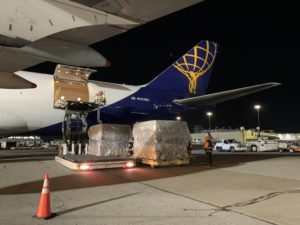
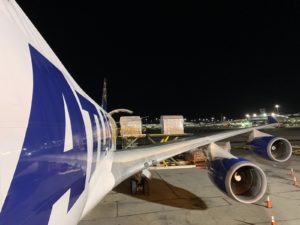
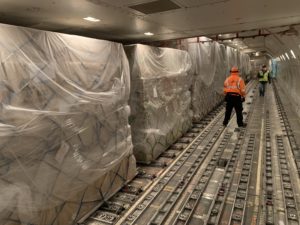
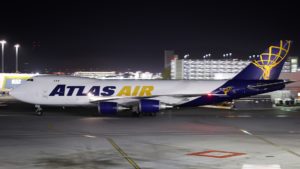
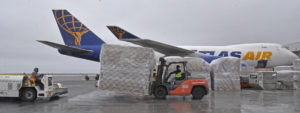
As the coronavirus situation continues to unfold, one thing is certain: Atlas is committed to supporting the global effort to protect healthcare workers and stem the spread of the virus.
On Sunday, an Atlas 747 touched down in JFK – from China – with 80 tons of desperately needed personal protective equipment (PPE) and medical supplies. This high-profile flight, funded by the Federal Emergency Management Agency (FEMA) as part of the White House’s Project Airbridge, carried 130,000 N-95 masks, nearly 1.8 million surgical masks and gowns, more than 10.3 million gloves; and more than 70,000 thermometers for distribution in New York, New Jersey, and Connecticut.
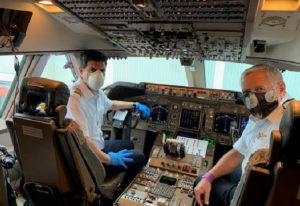 The journey began Sunday, March 28 at Shanghai Pudong International (PVG). According to crew on that first leg, our Shanghai station representatives did an outstanding job getting cargo loaded as efficiently and safely as possible. As a result, the flight departed at 4:18 a.m., local time and 42 minutes ahead of schedule.
First Officer Steve McKechnie was among the crew headed to Ted Stevens Anchorage International (ANC) and said, “It may have looked like a regular flight, but it was very special – and rewarding – given what we were carrying on behalf of FEMA.
Captain John Bell added, “I’m glad we could play a small role in this massive effort to protect our healthcare professionals and save lives.”
It was Captain David Moriconi who took over the left seat in ANC for the final leg to JFK. Like the previous crew, he was impressed by how well coordinated and smooth the flight was, from start to finish, including the stellar support provided by ANC operations and ground staff.
“As a native New Yorker, with a 92-year-old aunt locked up in Manhattan, it felt good, both personally and professionally to help my people,” said Captain Moriconi.
First Officer Alvaro Cardoso was also appreciative of the opportunity to help. He was originally slated for time off, but Scheduling called on Thursday, March 26 to ask if he would consider volunteering for this trip on his day off.
“It’s very scary and very concerning to see how COVID-19 cases are increasing exponentially on a daily basis all over the country, and particularly in New York City, which is now the new epicenter in the United States,” Alvaro said. “I didn’t hesitate in accepting this trip, because I believe each one of us has a duty to do something that might just make a difference.”
Also onboard was First Officer Usman Chatha, who was deadheading/jump seating on the flight. Although he was not part of the operating crew, he chose to travel in full uniform.
“I am so proud to be associated with an airline that is playing a crucial role in transporting medical supplies, including much-needed ventilators. We are witnessing unprecedented times and I was honored to be part of that flight.”
Usman continued, “Atlas Air is an ideal corporate citizen. It does not leave any stone unturned when it comes to delivering service from the military to civilians who need support.”
Jim Forbes, Executive Vice President and Chief Operating Officer described watching Sunday’s 747 landing in JFK as “a proud moment in Atlas’ history.”
“We are proud to support efforts to deliver extremely critical medical supplies to the United States, and we are so thankful to our crews for making this happen,” added John Dietrich, President and Chief Executive Officer of Atlas Air Worldwide.
PURCHASE, N.Y., April 2, 2020 – Atlas Air Worldwide Holdings, Inc. (Nasdaq: AAWW) confirmed that Tuesday, the federal district court in Washington D.C. ruled that the arbitration awards issued in favor of Atlas Air, Inc. and Southern Air, Inc. last summer are binding and enforceable. The court also directed the pilot union, the International Brotherhood of Teamsters, to provide the companies with an Integrated Seniority List by May 15, 2020, followed by joint collective bargaining for a finite period, with unresolved issues, if any, decided by binding arbitration.
The company said it is particularly grateful for the union’s strong collaboration in working to ensure the health and wellbeing of our crews operating during this coronavirus situation, and remains focused on working with the union leaders to negotiate the new joint contract.
“I want to thank all of our employees for their extraordinary commitment and service during these unprecedented times. Together as a team, we are supporting the efforts of companies and agencies across the public and private sectors to deliver life-saving supplies to where they are needed the most. Our pilots play a critical role in the global fight against coronavirus, and we are grateful for their ongoing dedication,” said John W. Dietrich, President and Chief Executive Officer, Atlas Air Worldwide.
“Despite the challenges of this global epidemic, we remain focused on completing an updated contract for our pilots. With respect to negotiations, we continue to meet regularly with union representatives and are making meaningful progress,” Mr. Dietrich said.
About Atlas Air Worldwide:
Atlas Air Worldwide is a leading global provider of outsourced aircraft and aviation operating services. It is the parent company of Atlas Air, Inc., Southern Air Holdings, Inc. and Titan Aviation Holdings, Inc., and is the majority shareholder of Polar Air Cargo Worldwide, Inc. Our companies operate the world’s largest fleet of 747 freighter aircraft and provide customers the broadest array of Boeing 747, 777, 767 and 737 aircraft for domestic, regional and international cargo and passenger operations.
Atlas Air Worldwide’s press releases, SEC filings and other information may be accessed through the company’s home page, www.atlasairworldwide.com.
* * *
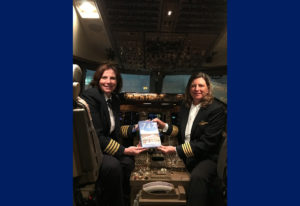 Captain Aileen Watkins
Captain Aileen Watkins remembers exactly when she became enamored with flying. “My father, who was a civil engineer, had been involved in extending the runways at JFK for the 747. He was invited to go to the delivery of a new Pan Am 747 in 1971 and brought me. That’s where it all began. I remember being equally fascinated with its size and its classic look. She was the biggest and the best.”
Throughout Captain Watkins’ childhood, aviation never lost its intrigue. Especially when her class studied Amelia Earhart. “That’s when I started to dream about becoming a pilot,” she recalls.
It wasn’t until the late 1980s however, that she really thought the dream could come true someday.
“I was watching a documentary series called “Reaching for the Skies” and one of the episodes featured Captain Lynn Rippelmeyer, the firstwoman to fly the Boeing 747. Seeing a woman in uniform really made me think becoming a pilot was possible. That image was incredibly inspiring to me.”
In a serendipitous turn of events, during an interview for an aviation scholarship, Captain Watkins shared the impact of the series with two female pilots. Unbeknownst to her, one of the interviewers was Captain Rippelmeyer.
Captain Watkins’ airline pilot career started with Continental Express; she then went to Alaska Airlines and then moved to United. Like Captain Kirby, 9/11 changed the trajectory of Captain’s Watkins’ career. She was the last new hire class at United prior to 9/11; after the tragic events she found herself out of a job. As a testament to her resiliency, she began working again in 28 days.
In 2004, Captain Watkins landed at Atlas, and she’s been here almost 16 years. She’s raised both of her daughters, and on her first flight as captain, she flew from Miami to Houston. Her husband, two daughters, and Captain Rippelmeyer watched her land on Runway 27 at her home airport, IAH (Houston Intercontinental).
When asked what the key to her success has been, it’s the advice she’s followed and shares with others: be passionate about what you choose to do, believe in yourself, be persistent, determined, and always strive for excellence.
When Elena Robson was six years old, she wanted to be a prince.
“I wanted to get out, see the world and slay the dragons. The princes were the ones who got to have the adventures and I didn’t want to stay home and wait for a prince,” Elena laughs.
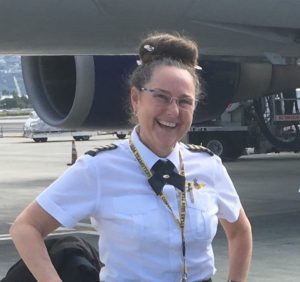 This quest for adventure was exactly what prompted Elena to consider aviation as a career. “I was in high school and on my way home back to Ithaca (New York) after an incredible, eye-opening experience in Alaska when I had what is a very classic pilot thought,” Elena recalls. “It suddenly occurred to me that if I became a pilot, I could go anywhere in the world.”
After returning home, Elena started researching how to become a pilot right away. She started community college and through a combination of loans, grants, and scholarships, including one from The Ninety-Nines International Organization of Women Pilots, transferred to Southeastern Oklahoma State University. Elena graduated with a Bachelor of Science in Aviation and was hired by Atlas in June of 1993 as a member of Class 7.
Today, Elena is a 747 captain and number one on the seniority list here at Atlas.
And that makes Elena smile. “At the start of my career, I was told I wasn’t strong enough to fly an airplane or make captain. Well, here I am today – still here after more than 20 years,” says Elena.
“I simply love what I do. I love the airplanes and I love exploring the world and seeing how it works,” she adds.
PURCHASE, N.Y., February 20, 2020 – Atlas Air Worldwide Holdings, Inc. (Nasdaq: AAWW) today announced fourth-quarter and full-year 2019 results that reflected a peak season with a pickup in customer demand and improved yields compared with the middle of the year.
In addition, the results reflected an impairment charge as well as actions taken to improve operating efficiencies and align resources with the company’s strategic priorities. The impairment resulted in lower aircraft rent and depreciation expense, which added to already higher than anticipated fourth-quarter and full-year 2019 adjusted results. The impact of lower aircraft rent and depreciation expense, coupled with actions to improve our business, are expected to benefit earnings in 2020 and beyond.
Reported results in the fourth quarter and full year of 2019 primarily reflected a noncash special charge associated with the write-down of the company’s 747-400 freighter fleet due to global airfreight and macroeconomic conditions resulting in lower 747-400 commercial cargo yields and utilization, as well as the disposition of certain nonessential Dry Leasing aircraft and engines.
“Our fourth-quarter reported results were certainly impacted by the one-time impairment. However, our solid adjusted results were driven by our team coming together to deliver the high-quality service that our customers appreciate,” said President and Chief Executive Officer John Dietrich.
As expected, reported and adjusted fourth-quarter results benefited from a refund of excess aircraft rent paid in previous years, lower heavy maintenance expense and aircraft ownership costs, an increase in military passenger and cargo flying, and the peak-season flying we do for express customers. Results were also impacted by the global airfreight environment and macroeconomic conditions, which reflected the effects of tariffs, global trade tensions and geopolitical unrest in certain countries in South America, and certain labor-related service disruptions.
Mr. Dietrich continued: “The airfreight industry, like most others, is experiencing the impacts of the unfortunate coronavirus outbreak. The effects are yet to be fully determined, and therefore our visibility into the full year ahead is evolving.
“In these unprecedented circumstances, we are playing a key role in our customers’ operating networks as they navigate this challenging time. We are also currently accommodating special charter demand, and we are well-prepared for the anticipated surge of volumes once manufacturing resumes in full force.”
He concluded: “Our focus remains on express, e-commerce, the U.S. military and faster-growing markets, where the demand for our aircraft and services is solid. As the global supply chain rebalances, we will continue to leverage our significant commercial charter business to capitalize on customer demand. Looking ahead, we anticipate that our financial performance in 2020 will be an improvement over 2019.”
The company’s 2020 outlook includes benefits from lower aircraft rent and depreciation, as well as a further refund in 2020 of excess aircraft rent paid in previous years. It also includes the impact in 2020 from an increase in the amortization of deferred maintenance; the absence in 2020 of return conditions income realized in the first quarter of 2019; and improved operating efficiencies and cost savings.
As a result, adjusted EBITDA is anticipated to grow by a mid-teens percentage in 2020, and adjusted net income is expected to increase by a high-30% to low-40% level compared with 2019.*
Fourth-Quarter Results
Volumes in the fourth quarter of 2019 totaled 84,488 block hours compared with 83,437 in the fourth quarter of 2018, with operating revenue of $747.0 million versus $765.0 million in 2018.
Reported results for the three months ended December 31, 2019, reflected a loss from continuing operations, net of taxes, of $410.2 million, or $15.86 per diluted share, which included a noncash special charge of $616.2 million ($485.2 million after tax) and an unrealized loss on financial instruments of $3.8 million. For the three months ended December 31, 2018, our reported income from continuing operations, net of taxes, totaled $211.0 million, or $2.73 per diluted share, which included an unrealized gain on financial instruments of $134.8 million.
On an adjusted basis, EBITDA totaled $204.7 million in the fourth quarter of 2019 compared with $196.4 million in the fourth quarter of 2018. Also on an adjusted basis, income from continuing operations, net of taxes, totaled $98.2 million, or $3.80 per diluted share, in the fourth quarter of 2019 compared with $87.0 million, or $3.12 per diluted share, in the fourth quarter of 2018. Adjusted net income in the fourth quarter of 2019 included $7.6 million (after tax) of lower aircraft rent and $2.9 million (after tax) of lower depreciation as a result of the impairment.
Lower operating revenue in the fourth quarter of 2019 compared with the fourth quarter of 2018 was primarily due to the impact of tariffs and global trade tensions on average Charter segment revenue per block hour and on ACMI segment volumes, and certain labor-related service disruptions, partially offset by an increase in Charter segment volumes.
Lower ACMI segment revenue during the period reflected a decline in 747-400 ACMI flying due to the impact of tariffs and global trade tensions on customer demand, partially offset by growth in 747-400, 777 and 737 CMI cargo flying.
Higher ACMI segment contribution during the quarter reflected a reduction in heavy maintenance expense, a decrease in aircraft rent and lower depreciation, and growth in 747-400, 777 and 737 CMI cargo flying.
Charter segment revenue in the fourth quarter of 2019 was relatively in line with the fourth quarter of 2018, driven by increases in cargo and passenger flying that were mainly offset by a decline in commercial cargo yields (excluding fuel) due to the impact of tariffs and global trade tensions, as well as geopolitical unrest in certain South American countries and certain labor-related service disruptions. Block-hour volume growth during the period primarily reflected increases in passenger and cargo demand by the military, as well as an increase in commercial cargo flying.
Lower Charter segment contribution was primarily driven by a decrease in commercial cargo yields and lower 747 freighter utilization. This impact was partially offset by increased military passenger and cargo flying, a reduction in heavy maintenance expense, and lower aircraft rent and depreciation.
In Dry Leasing, lower segment revenue and contribution during the quarter primarily reflected the scheduled return of a 777-200 freighter in 2019.
Lower unallocated income and expenses, net, during the quarter primarily reflected a $27.6 million refund of aircraft rent paid in previous years, partially offset by fleet-growth initiatives, leadership transition costs and increased amortization of a customer incentive asset.
Reported results in the fourth quarter of 2019 also included an effective income tax benefit rate of 21.4%, due mainly to nontaxable changes in the value of outstanding warrants. On an adjusted basis, our results reflected an effective income tax expense rate of 17.7%.
Full-Year Results
Volumes in 2019 totaled 321,140 block hours compared with 296,264 in 2018, with operating revenue increasing to $2.74 billion in 2019 from $2.68 billion in 2018.
Reported results for the twelve months ended December 31, 2019, reflected a loss from continuing operations, net of taxes, of $293.1 million, or $11.35 per diluted share, which included a noncash special charge of $638.4 million ($503.1 million after tax), partially offset by an unrealized gain on financial instruments of $75.1 million. For the twelve months ended December 31, 2018, our reported income from continuing operations totaled $270.6 million, or $5.22 per diluted share, which included an unrealized gain on financial instruments of $123.1 million.
On an adjusted basis, EBITDA totaled $504.8 million in 2019 compared with $551.3 million in 2018. For the twelve months ended December 31, 2019, adjusted income from continuing operations, net of taxes, totaled $139.6 million, or $5.24 per diluted share, compared with $204.3 million, or $7.27 per diluted share, in 2018. Adjusted net income in 2019 included $7.6 million (after tax) of lower aircraft rent and $2.9 million (after tax) of lower depreciation as a result of the impairment.
Reported results in 2019 also included an effective income tax benefit rate of 38.0%, primarily due to proactive tax planning resulting in the favorable completion of an IRS examination of our 2015 income tax return and, to a lesser extent, a tax benefit from nontaxable changes in the value of outstanding warrants. On an adjusted basis, our results reflected an effective income tax expense rate of 12.5%.
Cash and Short-Term Investments
At December 31, 2019, our cash and cash equivalents, short-term investments and restricted cash totaled $114.3 million, compared with $248.4 million at December 31, 2018.
The change in position resulted from cash used for investing and financing activities, partially offset by cash provided by operating activities.
Net cash used for investing activities during 2019 primarily related to capital expenditures and payments for flight equipment and modifications, including the acquisition of 747-400 passenger aircraft, 767-300 aircraft and related freighter conversion costs, spare engines and GEnx engine performance upgrade kits.
Net cash used for financing activities during the period primarily reflected payments on debt obligations.
2020 Outlook*
Based on global economic conditions and our current expectations, and subject to coronavirus developments, we expect to fly approximately 325,000 block hours this year, with about 75% of the hours in ACMI and the balance in Charter. We also anticipate full-year 2020 revenue of approximately $2.8 billion.
Including the impact in 2019 and the expected impact in 2020 of lower aircraft rent and depreciation resulting from the impairment charge in 2019, we expect adjusted EBITDA to grow by a mid-teen percentage in 2020 compared with adjusted EBITDA of $504.8 million in 2019. We also expect adjusted net income to increase by a high-30% to low-40% level in 2020 compared with adjusted net income of $139.6 million in 2019. Excluding the impact of lower aircraft rent and depreciation in both years, we anticipate that adjusted EBITDA and adjusted net income in 2020 will be comparable to or slightly higher than their 2019 levels.*
Our outlook reflects an expected refund in 2020 of excess aircraft rent paid in previous years; an increase in amortization of deferred maintenance compared with 2019; the absence in 2020 of return conditions income that we realized in 2019; and improved operating efficiencies and cost savings.
It also reflects the parking of four less-efficient 747-400 converted freighters since the beginning of 2020. We also plan to return one 747-400 freighter to its lessor in the first half of this year. In addition, we have sold a 757 freighter and expect to sell a 777 freighter and a 737 passenger aircraft.
Similar to historical patterns, we anticipate that more than three-quarters of our adjusted net income in 2020 will occur in the second half of the year.
Aircraft maintenance expense in 2020 is expected to total approximately $380 million. Depreciation and amortization is expected to total about $250 million. In addition, core capital expenditures, which exclude aircraft and engine purchases, are projected to total approximately $90 to $100 million, significantly lower than $134 million in 2019, mainly for parts and components for our fleet.
We also expect our full-year 2020 adjusted effective income tax rate will be approximately 21.0%.
Depending on developments related to the coronavirus, we expect to fly approximately 75,000 block hours (about 75% in ACMI) in the first quarter of 2020, with revenue of approximately $640 million. We also anticipate adjusted EBITDA of about $90 million, and adjusted net income ranging from approximately breakeven to a modest profit.
We provide guidance on an adjusted basis because we are unable to predict, with reasonable certainty, the effects of outstanding warrants and other items that could be material to our reported results.*
Conference Call
Management will host a conference call to discuss Atlas Air Worldwide’s fourth-quarter and full-year 2019 financial and operating results at 11:00 a.m. Eastern Time on Thursday, February 20, 2020.
Interested parties may listen to the call live at Atlas Air Worldwide’s Investor site or at https://edge.media-server.com/mmc/p/f7kdxxxq.
For those unable to listen to the live call, a replay will be archived on the Investor site following the call. A replay will also be available through February 28 by dialing (855) 859-2056 (U.S. Toll Free) or (404) 537-3406 (from outside the U.S.) and using Access Code 9016708#.
To supplement our financial statements presented in accordance with U.S. GAAP, we present certain non-GAAP financial measures to assist in the evaluation of our business performance. These non-GAAP measures include Adjusted EBITDA; Adjusted income from continuing operations, net of taxes; Adjusted Diluted EPS from continuing operations, net of taxes; Adjusted effective tax rate; and Free Cash Flow, which exclude certain noncash income and expenses, and items impacting year-over-year comparisons of our results. These non-GAAP measures may not be comparable to similarly titled measures used by other companies and should not be considered in isolation or as a substitute for Income (loss) from continuing operations, net of taxes; Diluted EPS from continuing operations, net of taxes; Effective tax rate; and Net Cash Provided by Operating Activities, which are the most directly comparable measures of performance prepared in accordance with U.S. GAAP. Effective during the three months ended September 30, 2019, we changed our method of calculating Adjusted EBITDA to include Other Non-operating expenses (income) to enhance the usefulness for investors and analysts, and the comparability of the calculation to that of other companies. Prior period amounts have been adjusted for comparability.
Our management uses these non-GAAP financial measures in assessing the performance of the company’s ongoing operations and in planning and forecasting future periods. We believe that these adjusted measures, when considered together with the corresponding U.S. GAAP financial measures and the reconciliations to those measures, provide meaningful supplemental information to assist investors and analysts in understanding our financial results and assessing our prospects for future performance. For example:
*We provide guidance on an adjusted basis and are unable to provide forward-looking guidance on a U.S. GAAP basis or a reconciliation to the most directly comparable U.S. GAAP measures because we are unable to predict with reasonable certainty the ultimate outcome of certain significant items. The principal item is the impact on our results of our outstanding warrants, which are highly dependent on the change in our stock price during the period reported. These items are uncertain, depend on various factors, and could have a material impact on our U.S. GAAP results.
Atlas Air Worldwide is a leading global provider of outsourced aircraft and aviation operating services. It is the parent company of Atlas Air, Inc., Southern Air Holdings, Inc. and Titan Aviation Holdings, Inc., and is the majority shareholder of Polar Air Cargo Worldwide, Inc. Our companies operate the world’s largest fleet of 747 freighter aircraft and provide customers the broadest array of Boeing 747, 777, 767 and 737 aircraft for domestic, regional and international cargo and passenger operations.
Atlas Air Worldwide’s press releases, SEC filings and other information may be accessed through the company’s home page, www.atlasairworldwide.com.
This release contains “forward-looking statements” within the meaning of the Private Securities Litigation Reform Act of 1995 that reflect Atlas Air Worldwide’s current views with respect to certain current and future events and financial performance. Those statements are based on management’s beliefs, plans, expectations and assumptions, and on information currently available to management. Generally, the words “will,” “may,” “should,” “expect,” “anticipate,” “intend,” “plan,” “continue,” “believe,” “seek,” “project,” “estimate,” and similar expressions used in this release that do not relate to historical facts are intended to identify forward-looking statements.
Such forward-looking statements speak only as of the date of this release. They are and will be, as the case may be, subject to many risks, uncertainties and factors relating to the operations and business environments of Atlas Air Worldwide and its subsidiaries (collectively, the “companies”) that may cause the actual results of the companies to be materially different from any future results, express or implied, in such forward-looking statements.
Factors that could cause actual results to differ materially from these forward-looking statements include, but are not limited to, the following: our ability to effectively operate the network service contemplated by our agreements with Amazon; our ability to coordinate with Amazon to accept newly converted aircraft; the possibility that Amazon may terminate its agreements with the companies; the ability of the companies to operate pursuant to the terms of their financing facilities; the ability of the companies to obtain and maintain normal terms with vendors and service providers; the companies’ ability to maintain contracts that are critical to their operations; the ability of the companies to fund and execute their business plan; the ability of the companies to attract, motivate and/or retain key executives, pilots and associates; the ability of the companies to attract and retain customers; the continued availability of our wide-body aircraft; demand for cargo services in the markets in which the companies operate; changes in U.S. and foreign government trade policies; economic conditions; the impact of geographical events or health epidemics; the effects of any hostilities or act of war (in the Middle East or elsewhere) or any terrorist attack; significant data breach or disruption of our information technology systems; labor costs and relations, work stoppages and service slowdowns; the outcome of pending negotiations with our pilots’ union; financing costs; the cost and availability of war risk insurance; aviation fuel costs; security-related costs; competitive pressures on pricing (especially from lower-cost competitors); volatility in the international currency markets; weather conditions; government legislation and regulation; consumer perceptions of the companies’ products and services; anticipated and future litigation; and other risks and uncertainties set forth from time to time in Atlas Air Worldwide’s reports to the United States Securities and Exchange Commission.
For additional information, we refer you to the risk factors set forth under the heading “Risk Factors” in the most recent Annual Report on Form 10-K and subsequent reports on Form 10-Q filed by Atlas Air Worldwide with the Securities and Exchange Commission. Other factors and assumptions not identified above may also affect the forward-looking statements, and these other factors and assumptions may also cause actual results to differ materially from those discussed.
Except as stated in this release, Atlas Air Worldwide is not providing guidance or estimates regarding its anticipated business and financial performance for 2020 or thereafter.
Atlas Air Worldwide assumes no obligation to update such statements contained in this release to reflect actual results, changes in assumptions or changes in other factors affecting such estimates other than as required by law and expressly disclaims any obligation to revise or update publically any forward-looking statement to reflect future events or circumstances.
* * *
“Caring for the World We Carry” Outlines Company’s Commitment to Corporate Citizenship
PURCHASE, N.Y., February 5, 2020 – Atlas Air Worldwide Holdings, Inc. (Nasdaq: AAWW) today announced the release of its first environmental, social and governance (ESG) report.
The 2018-2019 ESG report unveils the Atlas Air Worldwide ESG Vision: “Through responsibility, transparency and compliance, our vision is to be an aviation industry leader that partners with our stakeholders to foster economic and social progress while safeguarding the environment.” The report also highlights Atlas’ ESG policy, priorities, key commitments and initiatives, and identifies how Atlas aims to deliver tangible impact on issues that matter and also influence others in its industry and value chain to do so as well.
“Our ESG journey, which began with our founding in 1992, is rooted in our core values, which include our unyielding commitments to safety, security and compliance,” said John Dietrich, President and Chief Executive Officer of Atlas Air Worldwide. “We are focused on maintaining high standards of compliance with laws and regulations related to the environment, safety, corporate governance, ethics and data security in the U.S. and globally. This includes our commitment to be an industry leader in addressing aircraft fuel efficiency and reducing greenhouse gas emissions.”
Under the theme of “Caring for the World We Carry,” the report’s highlights include:
The Company reports on 13 priority ESG topics in three categories:
“We care deeply about having a positive impact on our people, communities and the world by being a catalyst for economic, environmental and social progress. Our goal is to deliver tangible impact on issues that matter and also influence others in our industry and value chain to do so as well,” said Mr. Dietrich.
Atlas Air Worldwide is a leading global provider of outsourced aircraft and aviation operating services. It is the parent company of Atlas Air, Inc., Southern Air Holdings, Inc. and Titan Aviation Holdings, Inc., and is the majority shareholder of Polar Air Cargo Worldwide, Inc. Our companies operate the world’s largest fleet of 747 freighter aircraft and provide customers the broadest array of Boeing 747, 777, 767, 757 and 737 aircraft for domestic, regional and international cargo and passenger operations.
Atlas Air Worldwide’s press releases, SEC filings and other information may be accessed through the company’s home page, www.atlasairworldwide.com.
* * *
Decisions Provide Clear Path Forward to Completing Contract Negotiations
Purchase, N.Y., January 28, 2020 – Atlas Air Worldwide Holdings, Inc. (Nasdaq: AAWW) today confirmed that Atlas Air, Inc. and Southern Air, Inc. have prevailed in dismissing two legal actions brought by their pilot union, the International Brotherhood of Teamsters. The union filed these lawsuits last summer, seeking to vacate the management grievance decisions issued in favor of the companies by arbitrators Richard Bloch and George Nicolau, respectively.
“With these rulings, we have a clear and timely path forward to delivering the updated contract that our pilots deserve. This is good news for our pilots,” said John W. Dietrich, President and Chief Executive Officer, Atlas Air Worldwide. “We remain committed to working collaboratively with union leaders to efficiently negotiate and complete the contract.”
The decisions rendered by the U.S. District Court for the District of Columbia upheld the companies’ position that the merger provisions in both the Atlas Air and Southern Air collective bargaining agreements apply. The merger provisions provide for a defined period of bargaining followed by binding interest arbitration for any unresolved issues.
With these court rulings now rendered, the union is required to promptly provide the companies with an integrated seniority list of pilots, which will enable negotiations to proceed more expeditiously in reaching a new, competitive pilot contract.
For more information about the contract negotiations process and updates, please visit AtlasAir5YPilots.com and follow @AtlasAir5Y on Twitter.
About Atlas Air Worldwide:
Atlas Air Worldwide is a leading global provider of outsourced aircraft and aviation operating services. It is the parent company of Atlas Air, Inc., Southern Air Holdings, Inc. and Titan Aviation Holdings, Inc., and is the majority shareholder of Polar Air Cargo Worldwide, Inc. Our companies operate the world’s largest fleet of 747 freighter aircraft and provide customers the broadest array of Boeing 747, 777, 767, 757 and 737 aircraft for domestic, regional and international cargo and passenger operations.
Atlas Air Worldwide’s press releases, SEC filings and other information may be accessed through the company’s home page, www.atlasairworldwide.com.
* * *
PURCHASE, N.Y., January 7, 2020 – Atlas Air Worldwide Holdings, Inc. (Nasdaq: AAWW) today announced that its Atlas Air, Inc. unit and EL AL Israel Airline Ltd. have entered into an agreement that enables EL AL to expand its reach and cargo lift for its customers.
Under the terms of the ACMI (aircraft, crew, maintenance and insurance) agreement, Atlas Air will operate a Boeing 747-400 Freighter for capacity on significant routes, mainly Liege – Tel Aviv, beginning in January 2020.
The 747-400 will provide additional revenue cargo volume to serve the strong growth in demand across EL AL’s freight network.
“This new agreement will allow EL AL to capitalize on the state-of-the-art service solutions provided by our aircraft,” said John Dietrich, President and Chief Executive Officer, Atlas Air Worldwide. “We welcome EL AL as a new customer and look forward to supporting EL AL as it continues to capture market opportunities and enhance its position as a leader in Israel’s cargo industry.”
Ronen Spira, head of EL AL’s Cargo Division, said, “We are committed to providing our customers with a variety of cargo solutions. This strategic initiative with Atlas Air enables us to provide our customers with a stable and high-quality operation for all types of cargo. Atlas Air’s fleet of 747 aircraft is well-suited to support EL AL’s operations and schedules.”
Atlas Air Worldwide is a leading global provider of outsourced aircraft and aviation operating services. It is the parent company of Atlas Air, Inc., Southern Air Holdings, Inc. and Titan Aviation Holdings, Inc., and is the majority shareholder of Polar Air Cargo Worldwide, Inc. Our companies operate the world’s largest fleet of 747 freighter aircraft and provide customers the broadest array of Boeing 747, 777, 767, 757 and 737 aircraft for domestic, regional and international cargo and passenger operations.
Atlas Air Worldwide’s press releases, SEC filings and other information may be accessed through the company’s home page, www.atlasairworldwide.com.
* * *
BOSTON and PURCHASE, N.Y., December 18, 2019 – Titan Aviation Holdings, Inc., a subsidiary of Atlas Air Worldwide Holdings, Inc. (Nasdaq: AAWW), and Bain Capital Credit, LP today announced that they have entered into an agreement to form a joint venture to develop a diversified freighter aircraft leasing portfolio with an anticipated value of approximately $1 billion. The long-term joint venture aims to capitalize on demand for cargo aircraft, underpinned by robust e-commerce and express market growth.
Under the joint venture, Bain and Titan have committed to provide $360 million and $40 million of equity capital, respectively, which may be supplemented with additional commitments over time, to acquire aircraft over the next several years. Titan will also provide aircraft- and lease-management services to the venture.
Since its inception in 2009, Titan has grown to become the third largest freighter lessor globally by fleet value with over 30 aircraft and book value of over $1.5 billion.
“We are delighted to team up with Bain,” said Titan President and Chief Executive Officer Michael T. Steen. “Both Bain and Titan share the same vision and investment strategy. Together, we are extremely well-positioned for further opportunities in the growing freighter space.”
“We have long admired Atlas and Titan as a best-in-class industry leader and are excited to join forces for a constructive and lasting partnership,” said Matt Evans, a Director at Bain Capital Credit. “We look forward to supporting the company’s next phase of growth as it continues to leverage its deep relationships within the global airfreight community.”
“We continue to leverage the scale and scope of our operations, and our leadership in global aviation outsourcing,” said Atlas Air Worldwide Chairman and Chief Executive Officer William J. Flynn. “We are executing the right strategies, including opportunities like this to grow our Titan dry-leasing business.
“We were impressed with Bain’s knowledge about our industry and its ability to join with us as we look to achieve our mutual goals. We appreciate Bain’s confidence in our long-term growth strategy, and we value its desire to partner with us.”
BNP Paribas acted as exclusive financial advisor and placement agent to Titan in the transaction, and Pillsbury Winthrop Shaw Pittman LLP acted as its legal advisor. Kirkland & Ellis LLP acted as Bain’s legal advisor in the transaction.
About Atlas Air Worldwide
Atlas Air Worldwide is a leading global provider of outsourced aircraft and aviation operating services. It is the parent company of Atlas Air, Inc., Southern Air Holdings, Inc. and Titan Aviation Holdings, Inc., and is the majority shareholder of Polar Air Cargo Worldwide, Inc. Our companies operate the world’s largest fleet of 747 freighter aircraft and provide customers the broadest array of Boeing 747, 777, 767, 757 and 737 aircraft for domestic, regional and international cargo and passenger operations.
Atlas Air Worldwide’s press releases, SEC filings and other information may be accessed through the company’s home page, www.atlasairworldwide.com.
About Bain Capital Credit
Bain Capital Credit (www.baincapitalcredit.com) is a leading global credit specialist with approximately $41 billion in assets under management. Bain Capital Credit invests up and down the capital structure and across the spectrum of credit strategies, including leveraged loans, high-yield bonds, distressed debt, private lending, structured products, nonperforming loans and equities. Our team of more than 200 professionals creates value through rigorous, independent analysis of thousands of corporate issuers around the world. In addition to credit, Bain Capital invests across asset classes including private equity, public equity and venture capital, and leverages the firm’s shared platform to capture opportunities in strategic areas of focus. Bain Capital Credit’s dedicated Private Credit Group focuses on providing complete financing solutions to businesses with EBITDA between $10 million and $100 million located in North America, Europe and Asia Pacific. Our dedicated global team affords us the ability to diligence the most complex situations and provide private capital to those companies.