Atlas Air avionics intern Pilar Florez recently helped lead the University of Cincinnati AeroCats to a standout performance at the SAE Aero Design East competition—an international collegiate event featuring more than 60 teams worldwide.
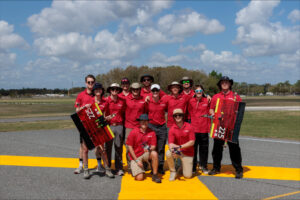
Competing in the Advanced Class for the first time since 2020, the team designed and built an aircraft capable of both conventional and vertical takeoff and landing (VTOL), and delivered one of the college’s strongest set of results in a decade:
Pilar credits her experience at Atlas with shaping both the team’s technical approach and competition strategy.
“Interning at Atlas exposed me to the realities of continuous, reliable flight operations,” she said. “In school, you focus on design, but competition success depends on execution—maximizing flight time and minimizing downtime.”
The team applied a structure similar to airline operations, organizing into dedicated Ground Ops, Flight Ops, and MRO (Tech Ops) groups—an approach that helped optimize performance and contributed to their top overall finish.
At Atlas, Pilar has been developing a Master Fleet Software Loading Matrix, consolidating software requirements across the fleet as part of the Aircraft Software Modernization Program. She has also supported software migration, documentation, and tooling updates.
Pilar credits Atlas engineers Randy Rogers and Jake Barnett for their mentorship and hands-on guidance.
“They invested in my growth and made sure I gained real aircraft experience,” she said. “That perspective made a significant difference both in my internship and in competition.”

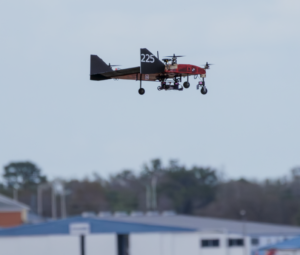
In-flight pictures of the plane flying conventionally and vertically.